Because of my upcoming video about higher category theory, I thought I would make this short blog post introducing categories and some related ideas about them. Therefore, this will be a pretty long blog post, with lots of advanced examples sprinkled in (they aren’t necessary for actually understanding the category theory itself, but they are really cool examples of how we can translate concepts from different areas of maths into category theory).
Introduction:
In category theory, there are certain concepts that pop up all the time. One of the most common is the “universal property”. This is a certain defining property which describes an object in a certain category
Example 1
Given a set 


which is given by mapping any element 


Example 2
In topology, the discrete topology on a set 

is continuous. More precisely, let 


where 

such that

commutes. Let’s unpack this a little bit more: the commutativity of the diagram means that 


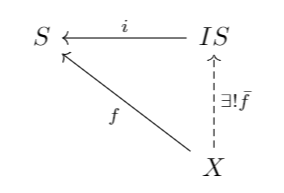
with the same explanation as before, except that this time the indiscrete topology has the universal property that any map

is continuous rather than any map
being continuous which was the universal property of the discrete topology.
Categories:
Definition 1
A (small) category 
- A set
of objects
- A set
of arrows (or morphisms) between two objects
and
.
- For a triple
of objects, there is a composition law

which we denote

We may also write compositions as follows:

The composition law must be associative and unital, that is: for any 


and there is a morphism 


Example 1
Consider the category Top of topological spaces, where the morphisms would be continuous maps.
Example 2
Consider the category Ab of abelian groups, or Grp of groups, where in both cases the morphisms are group homomorphisms.
Example 3
Consider the category Set of sets, where the morphisms are just functions.
Functors:
Definition 2
A (covariant) functor 


or if 

Definition 3
Given a category 


There are of course many very interesting examples of functors:
Example 1
We have so called “forgetful functors” which drop the added structure of the underlying set. For example:

which just sends a group 

Example 2
The fundamental group 

Example 3
The delooping of a group is a functor too. What the delooping of a group does is describe a group as a groupoid with one object. More precisely, given a group 


elements of

Example 4
The fundamental groupoid of a space
points in

But how exactly does it extend to a functor? The answer is that it extends to a groupoid

by sending a space 


![f_*([\alpha])=[\alpha\circ f]](https://s0.wp.com/latex.php?latex=f_%2A%28%5B%5Calpha%5D%29%3D%5B%5Calpha%5Ccirc+f%5D&bg=ffffff&fg=111111&s=0&c=20201002)
Natural Transformations:
A natural transformation can be thought of as a morphism between functors.
Definition 1:
A natural transformation 

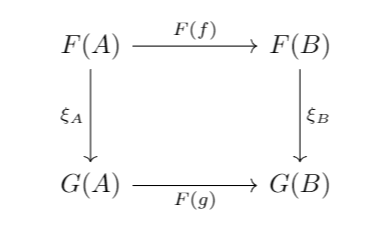
commutes.
Definition 2
We say that 


Example 1
A statement like
“A group is isomorphic to its opposite group”
can be expressed in terms of a natural isomorphism. More precisely, define the opposite of a group 

We can quickly move down to functors by defining


It is in fact a group homomorphism since

Now we can move up a level to natural transformations by saying:
The identity functor 

And so we have rephrased “A group is isomorphic to its opposite group” in terms of natural transformations.
Example 2
In algebraic topology, the Hurewicz homomorphism is also a natural transformation! This is because both

and

are functors, the Hurewicz homomorphism is natural for all 

A Glimpse at Higher Category Theory: The 2-Category of Categories
In order to avoid paradoxes and size issues like Russel’s paradox when talking about the “category of categories”, we restrict ourselves to small categories.
Now we have a tiny glimpse at higher category theory. In the category of small categories, we have the following data:
- Objects are just small categories
- Morphisms are functors
- 2-morphisms are natural transformations
But what are 
 Gregor's maths blog