Computing homotopy groups of spheres is an extremely complex topological problem, where much progress has been made, but there is much more still to do. There are many different approaches to their computations: fiber bundles and fibrations, spectral sequences etc. Here I will give an overview of some results with elementary methods which have been found. To get you excited: here is a table of their homotopy groups (taken from Hatcher’s text):
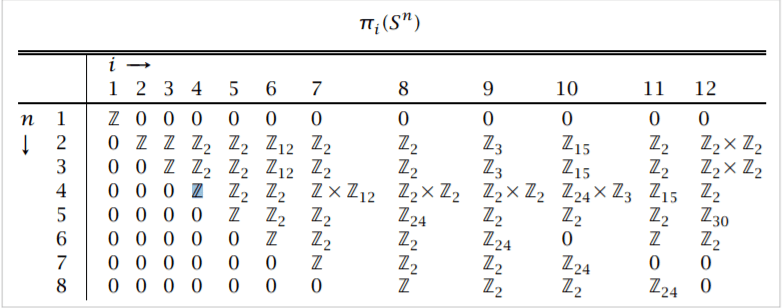
Clearly, many interesting patterns appear: one of the most obvious to see is that

Again, there are many zeros and it does follow that

Furthermore, we can see that
We can see that 

There are also more subtle patterns that emerge from this table: for example


Also the only infinite homotopy groups of spheres are


And it is fun to just look at the table and see if you can find some patterns. I will prove some of these theorems (all of the patterns spotted in this blog are true).


To do this, we shall use that 

Let 


is a bijection for 

where

I will be assuming this theorem, and can now use an inductive step to prove the general result I was trying to prove to begin with. One must take care however, since we can only show by this theorem that:

is a surjection. Therefore, all we need is to show that 

Fiber bundles are very nice in the sense that a fiber bundle

passes to a long exact sequence of homotopy groups

The long exact sequence breaks down into split short exact sequences

which splits because of the suspension homomorphism

The fact that this short exact sequence splits gives us:

Since 

Now that we have 

Note that the last part of this proof also showed that


The next thing we shall look at is called the Hopf invariant. Disclaimer: knowledge of cohomology is assumed.
Take a continuous map

Then, define the space 

for a 

Then choose generators 


are when

Furthermore, the Hopf invariant defines a homomorphism

Consider the CW cell complex 


The next computation I shall do is 


So the problem of what the homotopy groups 


(1) Use the exactness of

(2) The kernel of 
![[\text{id}, \text{id}]](https://s0.wp.com/latex.php?latex=%5B%5Ctext%7Bid%7D%2C+%5Ctext%7Bid%7D%5D&bg=ffffff&fg=111111&s=0&c=20201002)
(3) When 

![\pm[\text{id}, \text{id}]=2\eta](https://s0.wp.com/latex.php?latex=%5Cpm%5B%5Ctext%7Bid%7D%2C+%5Ctext%7Bid%7D%5D%3D2%5Ceta&bg=ffffff&fg=111111&s=0&c=20201002)

Corollary:

Corollary:


Finally we take a brief look at rational homotopy theory. The idea of rational homotopy theory is to “ignore torsion” of the homotopy groups of a space

tell you precisely when they will be infinite. Serre computed these homotopy groups and they are thus:


 Gregor's maths blog